

Why Rechargeable Flashlights Are the Future: USB vs Alkaline
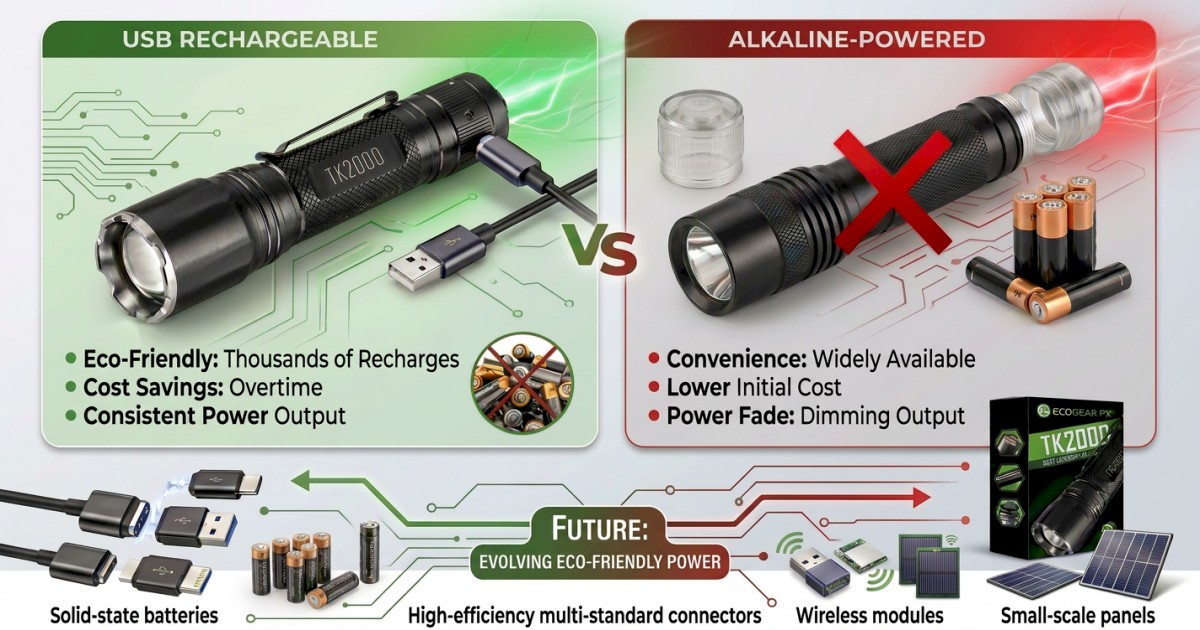
The Bright Shift: Why Rechargeable Flashlights Are the Future
When you reach for a flashlight in a dark garage, a power outage, or a weekend camping trip, you probably instinctively grab the one that’s already on the shelf. For decades that flashlight has been powered by disposable alkaline batteries. But the lighting market is undergoing a quiet revolution since the introduction of USB rechargeable flashlights and they are rapidly outpacing their alkaline‑powered cousins. The reasons go beyond mere convenience – they touch on cost savings, environmental impact, performance reliability, and the evolving expectations of modern consumers.
In this article we’ll unpack the advantages of rechargeable flashlights, compare USB charging to traditional alkaline power, and explain why the trend is more than a fad. By the end, you’ll understand why a USB‑ready, rechargeable beam is the smartest choice for everyday use and for the planet.
How Flashlight Power Works: A Quick Primer
At the heart of any flashlight is a power source that delivers voltage to an LED (or, in older models, a filament bulb). Alkaline batteries – typically AA or AAA – produce about 1.5 volts each and rely on a chemical reaction between zinc and manganese dioxide. The reaction is stable, but the battery’s capacity diminishes over time, especially in high‑drain devices like LEDs.
Rechargeable units, on the other hand, use lithium‑ion (Li‑ion), lithium‑polymer (Li‑Po), or nickel‑metal hydride (NiMH) cells. A single Li‑ion cell can provide 3.7 volts, meaning you often need fewer cells for the same brightness. These cells can be recharged hundreds of times, restoring close to 100% of their original capacity with each cycle. The key difference is reusability – a rechargeable cell can be topped up again and again, whereas an alkaline cell is dead after its one‑time discharge.
The Economic Edge: Cost Over Time
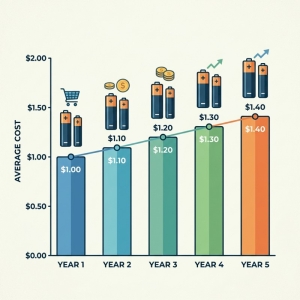 It’s tempting to look at the sticker price of a flashlight and decide based on the cheapest upfront cost. A basic alkaline‑powered flashlight might sell for $5, while a comparable USB‑rechargeable model can cost $20–$30. The real calculation, however, should factor in the lifetime cost of power.
Consider a typical household that uses a flashlight twice a month, draining about 200 mAh each session. An AA alkaline battery holds roughly 2,500 mAh, so you’d need a fresh battery roughly every 12 uses. At $0.75 per AA, that’s $0.75 × 24 = $18 a year. Over five years you’ve spent $90 on disposables.
A 1,200 mAh Li‑ion rechargeable pack, purchasable for $8–$12, can be recharged 300–400 times before its capacity falls below 80% of the original. Charging the pack from a USB wall adapter costs less than a cent per cycle. In other words, after the initial $25–$35 investment in a rechargeable flashlight, you’ll likely spend under $5 on electricity for the same five‑year span. The savings become even more dramatic for heavy users like hikers, emergency responders, or DIY enthusiasts.
Environmental Impact: Reducing Waste One Beam at a Time
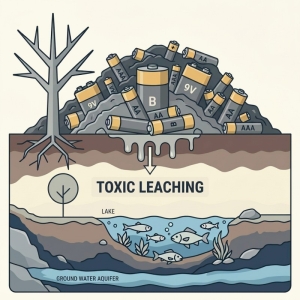 Every year, millions of alkaline batteries end up in landfills. Although many municipalities offer battery recycling programs, a significant portion still leaks heavy metals such as mercury, cadmium, and zinc into soil and groundwater. The production of each AA battery also consumes raw materials and energy, adding to its carbon footprint.
Rechargeable batteries drastically cut that waste. A single Li‑ion cell that replaces 300 alkaline batteries eliminates the need for roughly 450 kg of metal waste per 1,000 users. Moreover, the manufacturing impact of a Li‑ion cell is offset after about 50 charge cycles, meaning that after the first few months of use, the overall environmental burden is lower than that of an equivalent number of alkalines.
When you pair a rechargeable flashlight with USB charging, you also benefit from the growing prevalence of renewable‑powered chargers. Many households now have solar‑powered power banks or solar panels that can charge devices directly, further shrinking the carbon emissions associated with night‑time illumination.
Performance Benefits: Brightness, Consistency, and Smart Features
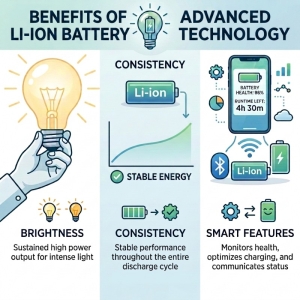 Alkaline batteries have a notorious tendency to voltage sag under load. As the LED draws current, the voltage can dip, leading to dimmer light and inconsistent output. This is especially noticeable in high‑lumens flashlights that push 2–3 amps.
Rechargeable Li‑ion packs maintain a steadier voltage throughout most of their discharge curve, delivering consistent brightness until the very end of the charge. Users experience a reliable beam intensity, which is crucial for safety in emergencies.
Beyond raw performance, modern rechargeable flashlights often integrate smart technology:
- Battery level indicators (LED bars or digital displays) give you a clear readout of remaining runtime.
- USB‑C fast charging can replenish a full charge in 1–2 hours, compared to the weeks it can take to replace a depleted alkaline set.
- Memory function remembers the last brightness setting, so you don’t have to re‑adjust after each charge.
- Programmable modes (strobe, SOS, low‑power reserve) are stored in firmware and can be accessed without extra switches.
These features add convenience and safety that an alkaline flashlight simply can’t match.
USB Charging vs. Alkaline Batteries: The Real Differences
USB charging has become the universal language of portable power. Here’s how it stacks up against older charging methods like dedicated wall adapters or solar panels.
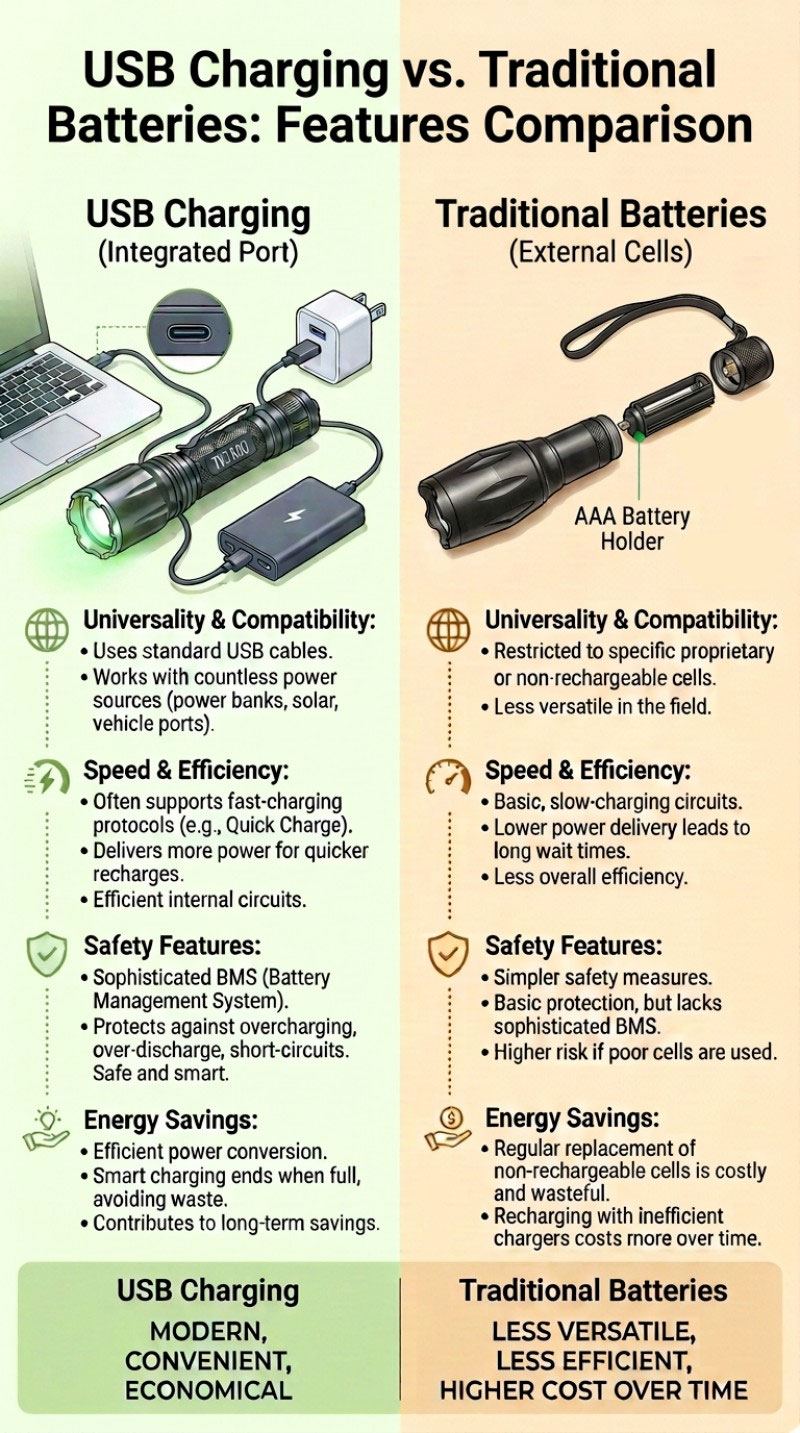
Universality and Compatibility
A USB‑C or micro‑USB port means you can plug the flashlight into a phone charger, a laptop, a car USB outlet, or a power bank. No need to carry a proprietary charger. This universality reduces the number of cables you need to own and travel with.
Speed and Efficiency
Modern USB‑C Power Delivery (PD) can deliver up to 20 W, enabling rapid charging of high‑capacity cells. In practice, a 2,000 mAh Li‑ion flashlight can go from 0% to 80% in under an hour. Traditional NiMH chargers, by contrast, often charge at a slow 0.1 C rate, meaning a 2,000 mAh pack could take 12–14 hours to fully charge.
Safety Features
USB chargers incorporate built‑in protection against over‑voltage, over‑current, and short circuits. This reduces the risk of battery swelling or fire – a concern with cheap, unregulated chargers that sometimes accompany low‑cost rechargeable flashlights.
Energy Savings
Because USB chargers are regulated, they waste less energy as heat. A typical wall adapter for alkaline flashlights (which often uses a low‑current DC output) can be up to 30% less efficient than a modern USB‑PD charger.
Real‑World Use Cases: Who Benefits Most?
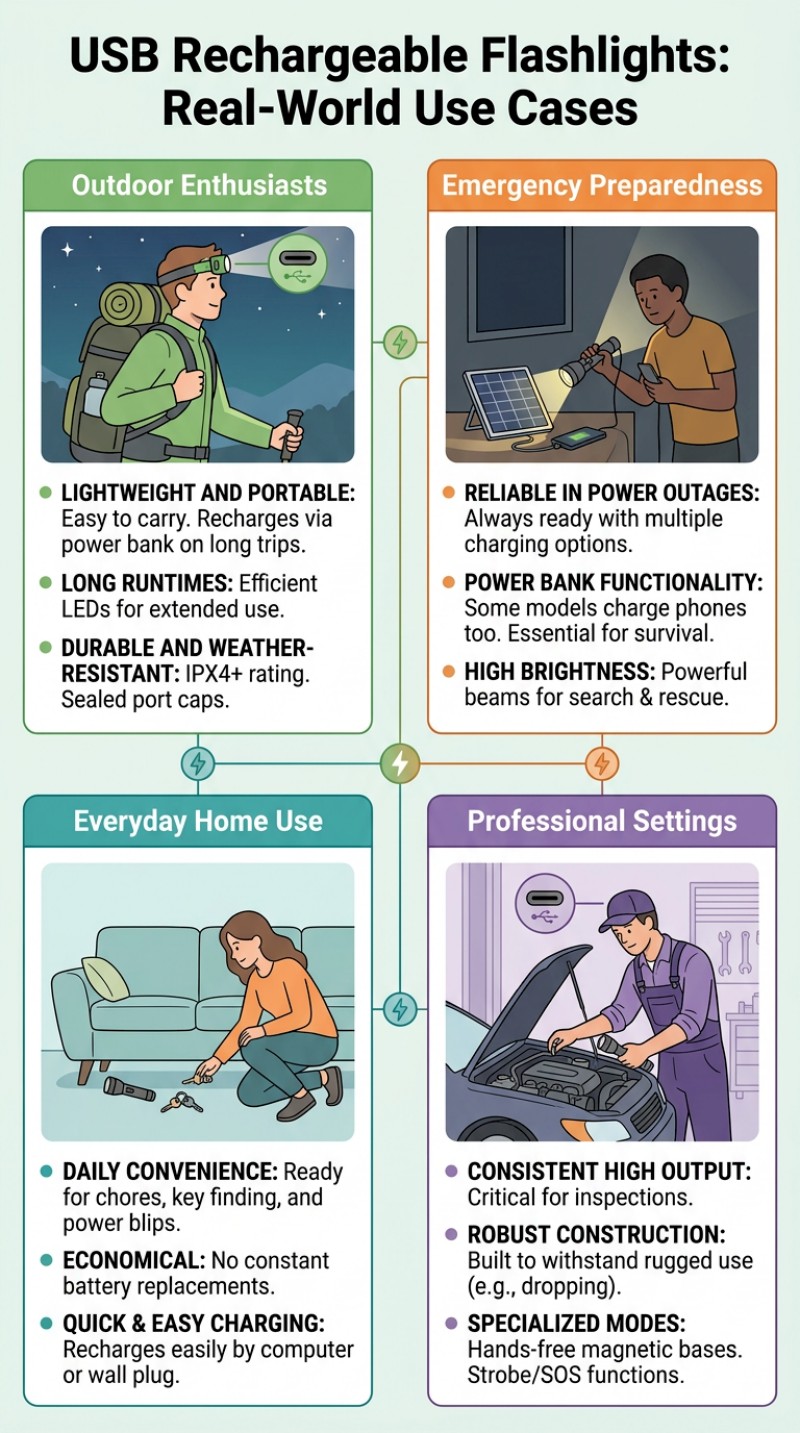
Outdoor Enthusiasts
Backpackers and campers love lightweight gear. A USB‑rechargeable flashlight eliminates the need to pack spare AA batteries, which add weight and bulk. Many hikers now carry a small solar power bank that can recharge both their phone and flashlight in a single afternoon.
Emergency Preparedness
During power outages, a reliable light source is critical. Rechargeable flashlights are perfect for your survival kit and should be kept on a charging dock, ensuring they’re always ready. Some models even feature hand‑crank generators as a backup, but the primary USB charge remains the most efficient method.
Everyday Home Use
From checking the basement fuse box to finding a key under the couch, most households use flashlights sporadically. A rechargeable unit that sits on a nightstand and charges overnight via a USB plug becomes a “set‑and‑forget” tool, removing the mental load of buying replacement batteries.
Professional Settings
Construction workers, electricians, and first responders rely on tools that never fail. The consistent voltage of Li‑ion cells ensures that high‑lumens floodlights stay bright during long shifts, while the built‑in battery indicator prevents surprise power loss.
Buying Guide: What to Look for in a Rechargeable Flashlight
- Battery Type – Li‑ion such as 18650 or 21700 rechargeable batteries offers the highest energy density, but Li‑Po can be thinner for ultra‑compact designs. NiMH is cheaper but heavier.
- Capacity (mAh) – Higher capacity means longer runtime. For most civilian use, 1,000–2,000 mAh is ample.
- Charging Port – USB‑C is future‑proof; micro‑USB is still common but may become obsolete.
- Lumens and Beam Distance – Match the output to your needs; 200–400 lumens is sufficient for household tasks, while 800+ lumens suits outdoor adventures.
- Durability – Look for an IPX rating of at least 4 (water‑resistant) and an impact‑resistant housing (e.g., aluminum alloy).
- Smart Features – Battery level indicator, memory mode, and multiple lighting profiles add real value.
Myths Debunked: Common Concerns About Rechargeables
Myth 1: Rechargeable batteries explode. Modern Li‑ion cells include multiple safety circuits that prevent over‑charging, overheating, and deep discharge. Explosions are rare and usually stem from using counterfeit cells or improper chargers.
Myth 2: They don’t hold a charge as long as alkalines. While alkaline voltage drops steadily, Li‑ion maintains near‑full voltage until the last 10% of capacity. In practice, you get more usable light per charge.
Myth 3: USB charging is slow. With USB‑C PD, you can achieve 1C or higher charge rates, which is faster than most traditional chargers. Even a modest 5 V/2 A wall adapter will refill a 1,500 mAh pack in about an hour.
Myth 4: They’re expensive. The upfront price may be higher, but the lifetime cost—including battery replacement and electricity—is significantly lower.
The Future Landscape: What’s Next for Flashlight Tech?

As the world moves toward a circular economy, manufacturers are designing flashlights with modular batteries that can be swapped or upgraded. Expect to see solar‑integrated USB panels that let you charge directly from sunlight without a separate power bank. Additionally, smart integration with voice assistants (e.g., Alexa‑compatible flashlights) is emerging, allowing hands‑free activation.
The convergence of USB‑C universal charging, high‑density Li‑ion cells, and eco‑focused design points to a future where disposable batteries become a niche relic, reserved perhaps only for ultra‑low‑cost, single‑use gadgets.
Making the Switch: Practical Steps
- Audit Your Current Stock – Count how many alkaline batteries you have sitting in drawers. Calculate the approximate cost to replace them over the next year.
- Choose a Reliable Model – Use the buying guide above to pick a flashlight that matches your use case and have well‑reviewed USB‑rechargeable lines.
- Set Up a Charging Station – Designate a USB hub near your entryway or nightstand. Plug your flashlight in overnight; most units have built‑in over‑charge protection, so you can leave them safely.
- Recycle Old Batteries – Take your used alkalines to a local recycling drop‑off. Many hardware stores and community centers accept them.
- Track Savings – After a month, note how many times you charged versus how many alkalines you would have bought. The tangible savings reinforce the habit.
Conclusion: Illuminating the Path Ahead
The argument for rechargeable flashlights is no longer about convenience alone; it’s a compelling blend of economics, sustainability, performance, and modern connectivity. USB charging removes the friction of proprietary adapters, while lithium‑based cells deliver consistent, powerful light for hundreds of cycles.
If you still keep a dusty box of AAA batteries in your garage, consider swapping them for a sleek, USB‑rechargeable flashlight. You’ll enjoy brighter, steadier illumination, save money, and play a small but meaningful part in reducing the mountain of disposable batteries that ends up in landfills each year.
The future of portable light is already here – it just needs to be plugged in.
Key Takeaways
- Rechargeable flashlights cost more upfront but save money and reduce waste over their lifespan.
- USB‑C charging offers universal compatibility, fast charge times, and built‑in safety.
- Lithium‑ion batteries maintain consistent voltage, delivering reliable brightness until the final charge.
- Choosing a model with a battery indicator, durable housing, and appropriate lumen output maximizes utility.
- Switching to rechargeables supports a greener, more circular economy while delivering superior performance.
Ready to make the switch? Look for a USB‑C rechargeable flashlight with at least 1,000 mAh capacity, IPX4 rating, and a clear battery indicator. Your wallet and the planet will thank you.