

18650 vs. 21700 Batteries: The Ultimate Comparison Article
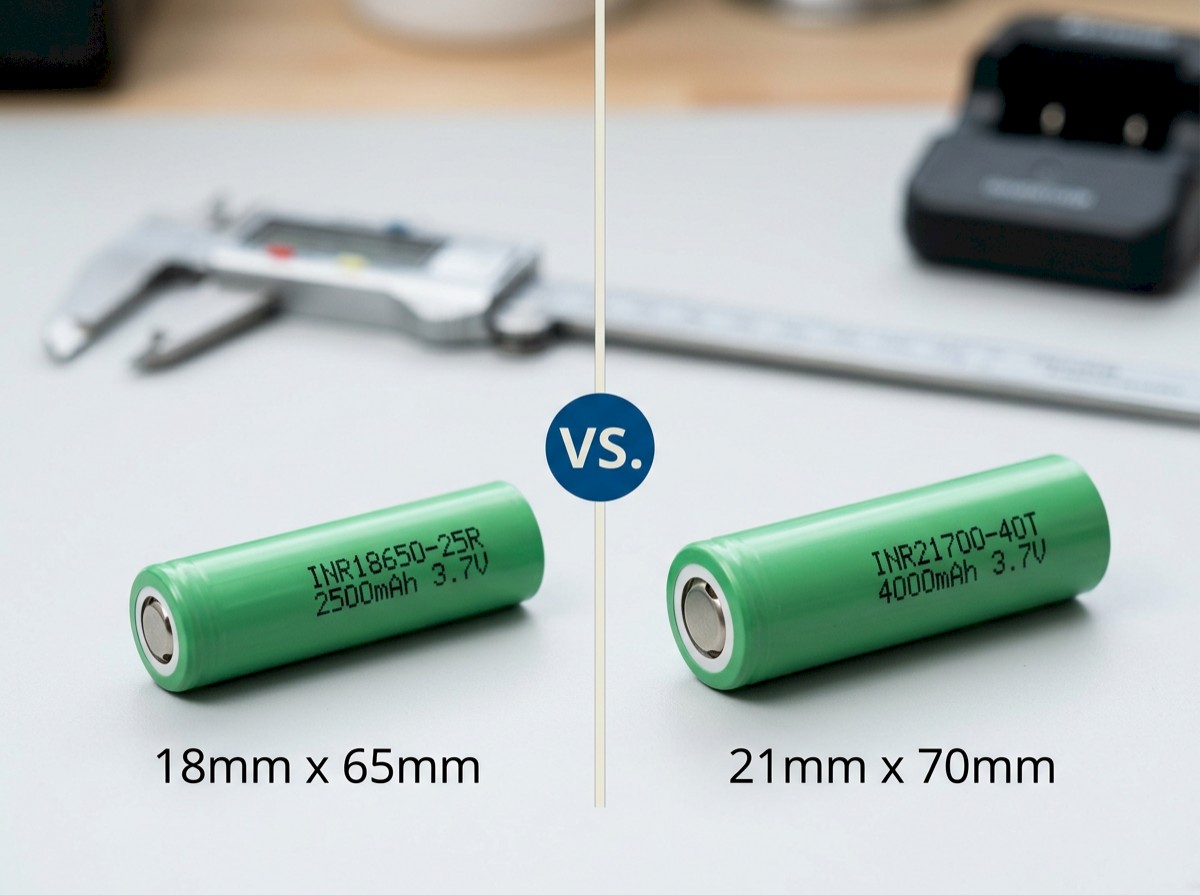
When you start hunting for a replacement cell for a flashlight, vape mod, or electric bike, you quickly discover that not all lithium‑ion cylinders are created equal. The two most common formats you’ll see on retailer shelves are the 18650 and the newer 21700. Their numbers aren’t random; they describe the cell’s dimensions: 18 mm diameter × 65 mm length for the 18650, and 21 mm × 70 mm for the 21700. That extra 3 mm in diameter and 5 mm in length translates into a noticeable jump in capacity, power delivery, and ultimately, the user experience. In this article we’ll break down every practical difference—capacity, discharge rates, safety features, cost, and real‑world use cases—so you can decide which format is the ideal fit for your gadgets.
The Basics: Chemistry and Construction
Both the 18650 and the 21700 belong to the broader family of cylindrical lithium‑ion (Li‑ion) cells. They share the same core components: a graphite anode, a lithium‑metal oxide cathode (commonly NCA or NCM), a separator, and an electrolyte. Because the chemistry is essentially identical, the performance gap between the two sizes is driven largely by cell geometry and internal design rather than a fundamentally different electrochemical reaction.
Electrode Area and Energy Density
Increasing the diameter of a cell expands the surface area of both the anode and cathode. More electrode area means more lithium ions can be stored and released, boosting energy density (measured in watt‑hours per kilogram, Wh/kg). A typical high‑quality 18650 might deliver 2600–3400 mAh at 3.6‑3.7 V, equating to roughly 9–12 Wh. By contrast, a modern 21700 can push 4000–5000 mAh, yielding 14–18 Wh in a similarly sized package. The larger cell also tolerates thicker electrodes, which improve power density (how quickly you can draw that energy) without overheating.
Internal Resistance and Heat Management
Because the 21700 houses a larger volume of active material, it can be engineered with a lower internal resistance (IR). Lower IR translates into less voltage sag under load and reduced heat generation. For high‑draw applications—think power tools or high‑performance flashlights—this difference can be the line between smooth operation and premature thermal throttling.
Capacity Showdown: How Much Juice Do They Hold?
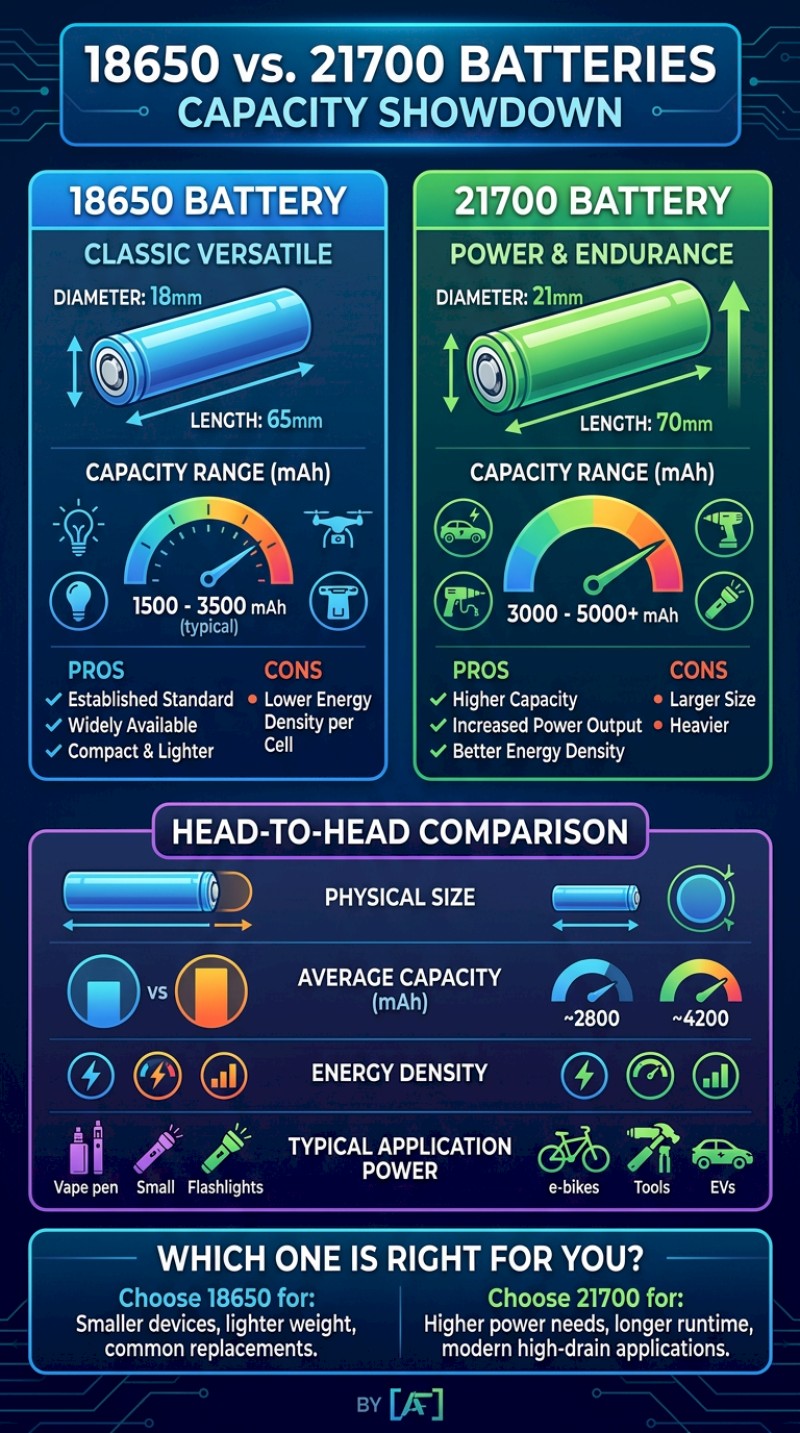
If you’re measuring a battery’s worth by how long it can keep a device alive, capacity is the headline metric. Let’s look at a realistic range of cells you’d find on the market today.
- 18650: 2600 mAh (budget), 3000 mAh (mid‑range), 3400 mAh (premium). Energy content hovers between 9.5 Wh and 12.5 Wh.
- 21700: 4000 mAh (standard), 4250 mAh (high‑energy), 5000 mAh (performance‑oriented). Energy content spans roughly 14.8 Wh to 18.5 Wh.
The math is simple: a 21700 packs roughly 45‑70 % more energy than an 18650 of comparable quality. That extra capacity can extend the runtime of a headlamp by several hours or give an e‑bike motor a few extra miles before you need to recharge.
Real‑World Example: Flashlight Runtime
Consider a 1500‑lumens tactical flashlight that draws 5 A at 3.7 V (about 18.5 W). An 18650 at 3000 mAh provides roughly 11.1 Wh, delivering around 35 minutes of continuous output before voltage drops below usable levels. Swap in a 5000 mAh 21700, and you get about 54 minutes—a 55 % increase in runtime with no change to the device’s optics or heat sink.
Discharge Rates: Power When You Need It
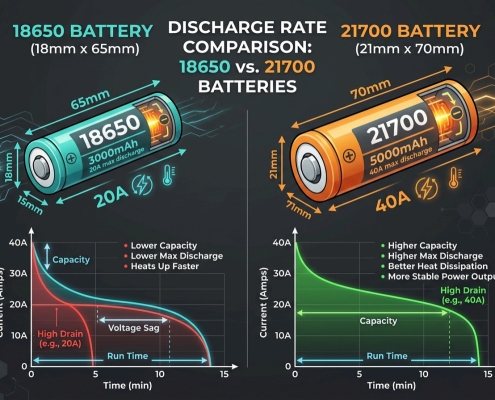 Capacity tells you how long a battery lasts; discharge rate tells you how hard it can work. The C‑rating (capacity multiplied by discharge current) is the standard way to compare. A 10 C rating on a 3000 mAh 18650 means it can safely deliver 30 A. However, most consumer 18650 batteries are limited to 10‑15 C, while many 21700 batteries are built for 20 C or higher.
High‑Drain Devices
Vape mod enthusiasts know the pain of a cell that can’t keep up with a 100‑W coil. A 21700 rated at 20 C can supply 100 A for a brief burst, whereas a typical 18650 would struggle beyond 30‑40 A and risk overheating. The same principle applies to power tools, RC cars, and electric scooters. The larger internal volume allows manufacturers to use multiple copper tabs and a more robust separator, both of which reduce heat buildup during high‑current draws.
Continuous vs. Burst Ratings
It’s worth noting that most specifications list continuous discharge limits, while burst limits are higher but only for short intervals (seconds to a few minutes). A 21700 with a 15 A continuous rating might handle a 30 A burst for 30 seconds—perfect for a drone that needs a quick power spike during acceleration.
Safety: What the Numbers Hide
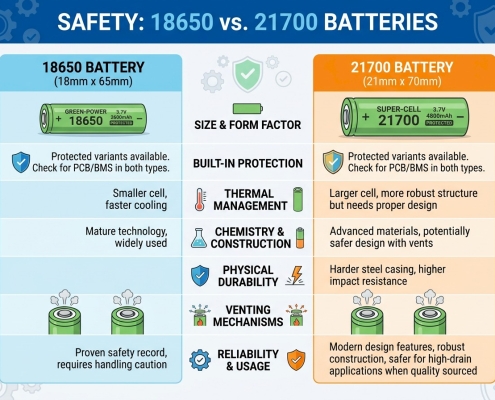 Lithium‑ion safety is a hot topic, and the larger format does not automatically mean a safer or riskier cell. Safety is a function of cell design, protective circuitry, and user handling.
Thermal Runaway and Venting
Because a 21700 contains more energy, a failed cell can release more heat if it goes into thermal runaway. However, modern 21700 cells often incorporate improved separator materials that shrink‑stop the propagation of a short circuit. Manufacturers also use pressure‑relief vents sized for the higher internal pressure, which helps direct gases away from the device.
Protection Boards and BMS
When using these cells in packs, a Battery Management System (BMS) is essential. A good BMS monitors voltage, current, temperature, and balances cells during charge. The larger cell’s lower IR means the BMS can more easily keep the temperature within safe limits, reducing the likelihood of an over‑heat event. This type of battery protection is commonly found in rechargeable USB flashlights.
User Practices
Regardless of size, follow basic safety habits: avoid over‑charging, never expose cells to direct flame, and store them at 40‑60 % charge for long‑term storage. Using a reputable charger with built‑in balance detection is the single most important step to keep any Li‑ion cell safe.
Cost Comparison: Is Bigger Always Pricier?
At first glance, a 21700 may seem more expensive because it’s newer and larger. In reality, the price gap has narrowed dramatically as manufacturers ramp up production.
- 18650: $4‑$7 per cell for mainstream brands, $9‑$12 for high‑performance variants.
- 21700: $5‑$9 for standard energy cells, $10‑$15 for high‑discharge models.
When you factor in energy per dollar, the 21700 often wins. A 5000 mAh 21700 at $9 delivers roughly 0.56 Wh per cent, whereas a 3000 mAh 18650 at $5 gives 0.48 Wh per cent. For hobbyists who swap cells frequently, the slightly higher upfront cost of a 21700 pays off in longer runtimes and fewer replacements.
Compatibility: Can You Swap Them?
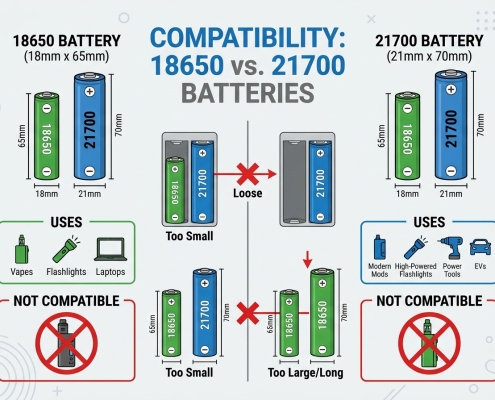 One of the most common questions is whether a 21700 can drop into a device built for 18650s. The answer is usually no, unless the device’s battery compartment is designed with a flexible mounting system.
Physical Fit
The 21700 is about 4 mm wider and 5 mm longer. In a tight flashlight housing, that extra bulk can prevent the battery from seating properly, leading to poor contact or even damage to the spring. Some manufacturers provide adjustable sleeves or dual‑size bays that accept both formats, but they are the exception rather than the rule.
Electrical Compatibility
Even if the battery fits, the device’s voltage and current handling must align. Most 18650‑based gadgets expect a maximum continuous draw of 10‑15 A. Feeding a 20‑A capable 21700 into the same circuit can overload the wiring or the device’s internal protection, potentially causing a shutdown.
When Swapping Is Safe
If a device explicitly lists compatibility with both sizes—common in newer high‑performance flashlights and some e‑bike battery packs—then swapping is safe. Always check the manufacturer’s specifications before mixing and matching.
Real‑World Applications: Where Each Shines
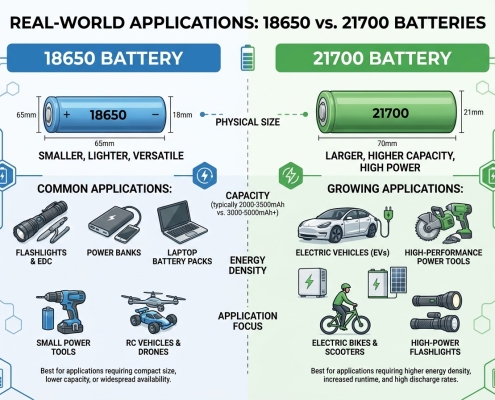 Understanding the technical specs is one thing; seeing how they translate into daily use helps solidify the decision.
18650: The Workhorse
- Portable electronics: Laptops, power banks, and handheld gaming consoles often use 18650s because the form factor fits slim designs.
- Budget flashlights: Entry‑level tactical lights and bike lights rely on the 18650’s balance of size, cost, and adequate capacity.
- Vape mods: Many mid‑range mods are built around 18650s, offering a good mix of capacity and moderate discharge.
21700: The Power Player
- High‑performance flashlights: Professional searchlights and tactical beams that demand >30 W benefit from the 21700’s higher energy and lower sag.
- Electric vehicles and e‑bikes: Manufacturers use 21700 cells in pack configurations to maximize range while keeping weight manageable.
- RC hobbyists & drones: The high‑C rating of many 21700s delivers the burst power needed for rapid acceleration and lift.
Future Trends: Where Are We Headed?
The lithium‑ion market is evolving fast. As the industry pushes for higher energy density, the 21700 is gaining traction, but a newer larger format— the 4680— is already on the horizon, promising even greater capacity and lower cost per kWh. However, for the next few years, the 18650 and 21700 will dominate consumer and hobbyist segments.
Recycling and Sustainability
Both cell types are recyclable, but the larger 21700’s higher energy per unit means fewer cells are needed for the same total capacity, potentially reducing waste in large‑scale applications like EVs.
Emerging Chemistries
Silicon‑anode and solid‑state variations are being introduced on both 18650 and 21700 platforms. These advances aim to boost capacity without increasing size, which could blur the performance gap in the future.
Bottom Line: Which Battery Wins?
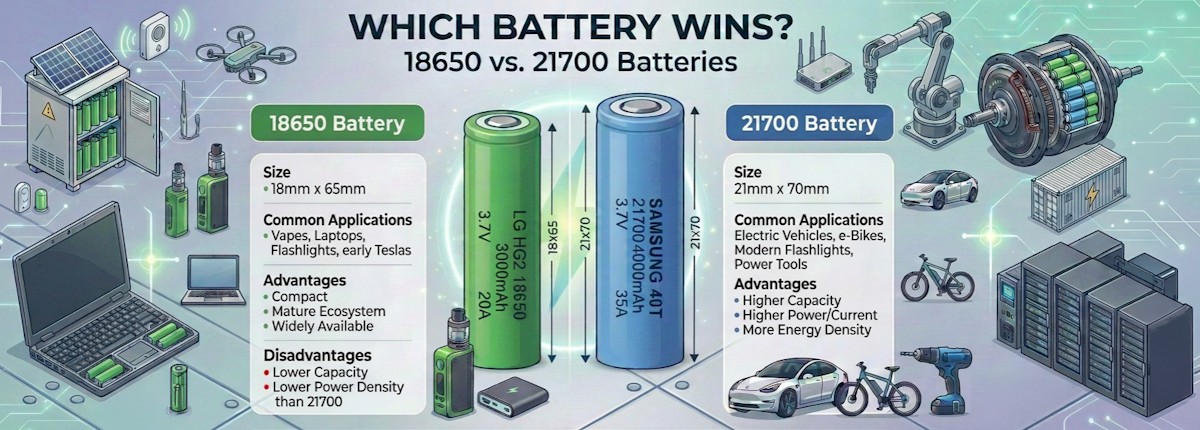
Choosing between 18650 and 21700 hinges on three core factors:
- Device requirements – If your gadget has a tight battery compartment or modest power draw, stick with the 18650. If you need longer run time or higher burst power, the 21700 is the clear winner.
- Budget vs. performance – While 21700 cells may cost a dollar or two more, they deliver more watt‑hours per dollar, making them more cost‑effective for heavy users.
- Safety and handling – Both formats are safe when used with proper chargers and BMS. The larger cell’s lower internal resistance can make it slightly easier to keep cool under load.
In a nutshell, the 21700 is the premium choice for power‑hungry, space‑flexible devices, while the 18650 remains the reliable, budget‑friendly workhorse for everyday electronics. Understanding your specific needs will ensure you pick the right cell and get the most out of your gear.
Ready to upgrade? Have a look at our cells that match the specifications to your device, and always use a charger designed for the exact chemistry. Happy powering!